News
What happens at the weirs each week: the repairs, the visits and the state of the monument, told by the people who work on them.
What happens at the weirs each week: the repairs, the visits and the state of the monument, told by the people who work on them.
The association keeps its own blog. These are the most recent posts; clicking any of them opens the full entry.
The association writes its blog in Spanish. Your browser can translate it.
.jpeg)
Los corraleros Margallo y Capote han completado nuevos trabajos de mantenimiento en el muro del corral de San Clemente durante la última marea baja. Las mareas vivas y…
Read on the blog →.jpg)
El pasado viernes 9 de octubre visitamos la torre de control de la Base Naval de Rota para agradecer al personal de los Servicios Aéreos (SEARO) su colaboración durante…
Read on the blog →
Hoy recibimos al primer grupo de visitantes de nuestro nuevo programa de invierno. Es un hito para la asociación: por primera vez en la historia organizamos visitas…
Read on the blog →
Queremos felicitar públicamente a Carolina Bonhomo Núñez, técnica de Medio Ambiente del Ayuntamiento de Rota. En el reciente acto del Santo Ángel, la Policía Local le…
Read on the blog →
La Policía Local de Rota entregó la Medalla al Mérito a nuestra asociación durante los actos del Santo Ángel, patrón del cuerpo. El acto se celebró en el salón capitular…
Read on the blog →
Ayer recibimos en los corrales a un grupo de trabajadores de la empresa GTC, llegados desde distintos países. El equipo celebraba su encuentro anual en el Hotel Playa de…
Read on the blog →Every wall that survives a storm and every channel that drains properly is the work of members who walk out at low tide.
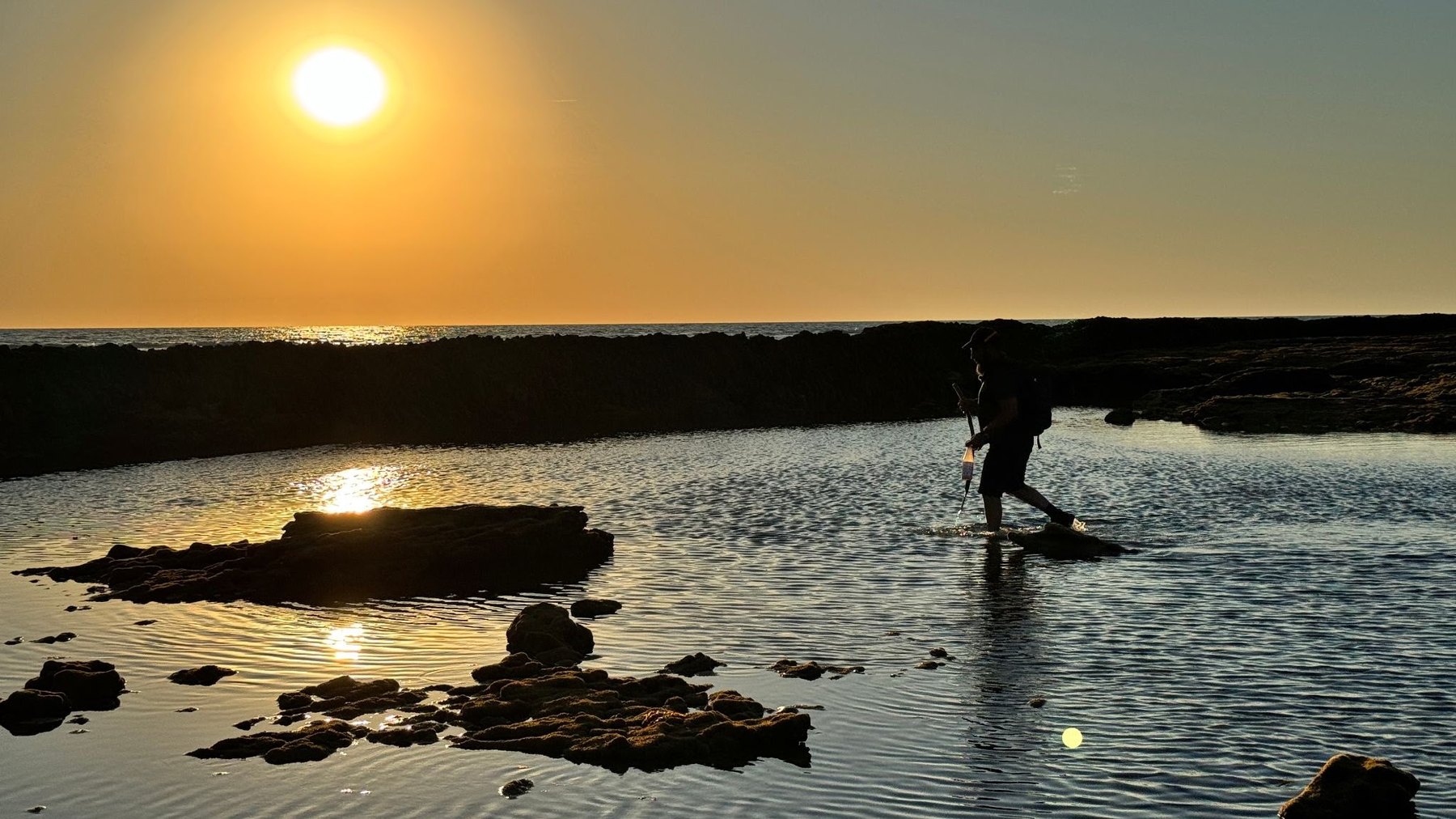
Tidal weirs do not look after themselves. Invasive seaweed blocks the channels, the water fails to drain during the ebb, and the pressure tears the wattle panels out at their base. Fixing it is manual work, done in the few hours the tide allows, and it has to be done again and again.
We publish that work because it is the clearest way to show where the association's funding goes, and because some of the storm damage is beyond what it can take on alone.
A guided visit is the way to see the weirs from the inside, and it funds their conservation.